

Sheffield Deer Park Background
Sheffield is noted for its great industrial past with steel manufacturing, engineering, mining and cutlery production, but what it is not known for is that it had one of the largest medieval deer parks in the country which was referred to as “Ye Great Parke.”
It spanned a circumference of eight miles in total, walled and fenced. Although there were around 2,000 deer parks at the end of the 15th century their size would only have been in the range of around one to two miles. The Sheffield Deer Park would have been quadruple the size of an average large deer park of its time, containing at the park’s zenith approx 3,000 deer (mainly fallow) and some of the largest oak trees ever recorded in England.
Sheffield Park was a Baronial Castle Park, where the Castle (Sheffield Castle) was located on the edge of the Park and then extended away like a large balloon or a rounded rectangle. This shape would then make it easier to use the park pale system of enclosure ensuring there are no sharp corners and being more economical.
Timeline and History of the Sheffield Deer Park
The Park was officially formed in Norman Times by Thomas de Furnival but it is believed to have Anglo-Saxon origins. This is because the ancient veteran oaks predate the Norman era. From around the 16th century and into the 17th century, the park ceased to be totally a deer park. Large parts were converted into pasture and arable land with tenants renting strips of land to grow crops. Isolated farmsteads sprang up with other parts for quarrying and a coal mine. By 1637 Harrison’s survey indicated 1,200 deer in total with the deer park only about 40% of its original size.
What made the Deer park so special were the thousands of veteran oak trees with some listed in John Evelyn’s 18th century book “Silva” which recorded the great trees (in previous centuries) throughout the country. Sheffield Deer Park supplied a number in his book, none more than the great oak tree situated in the Conduit plain, located just above the City Road Cemetery in modern times. This tree could shelter more than 250 horses under its foliage and there were many other trees of a similar magnitude.
Sheffield Great Deer Park Layout
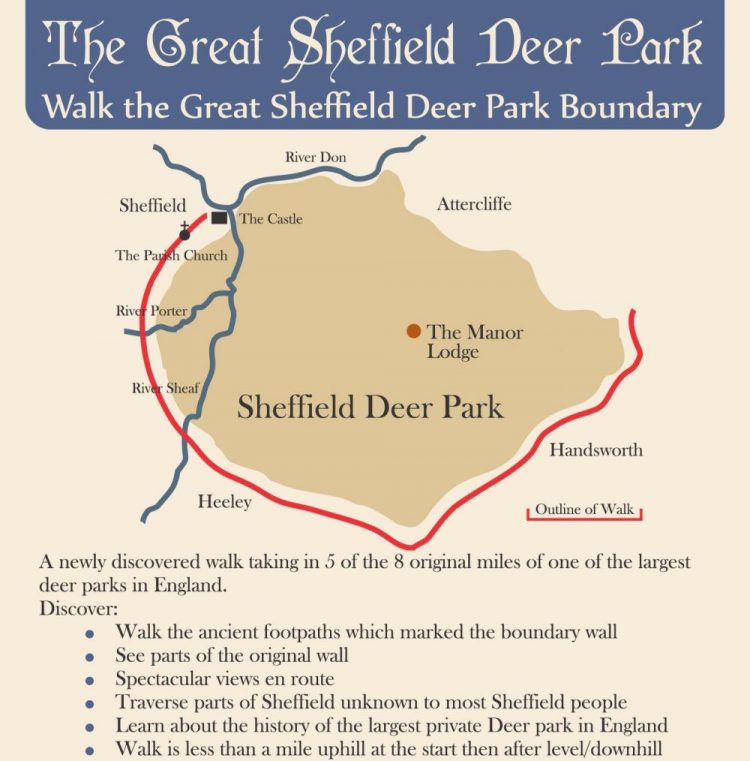
The Park commenced at the just below the Castle entrance where the Park gates were situated and followed a northerly direction tracing the river Don before turning eastwards towards Attercliffe. After several miles, it ceased following the river Don and turned in a southwards direction tracing a line close to and parallel with what is now the modern Sheffield Parkway.
On reaching Bowden Housted woods at Darnall, it then turned in a westerly direction following the Car Brook and parallel to what is now the modern Sheffield Ring Road (Prince of Wales Road). On reaching its highest point at what is now called Manor Top, we come across the other main gates, called the Intake gate. Entry through here (private by invitation only) would have led direct to the Park gate. It followed a line parallel to the present City Road and was a superb walnut avenue of trees creating a major landmark in the town.
From the Intake gate, the edge of the park continued in a southerly direction until reaching what is now referred to as Gleadless Valley and a wooded area called Buck Wood (named Berrysforth Wood in earlier times.)
This is the most southerly point and then continuing through Buck Wood in a westerly direction we reach Heeley and then on to the outer reaches of the town (as it was then) through to the present Bramall Lane, The Moor, Union Street, Norfolk Street and finishing at the starting point of the Park Gate.
Sheffield Deer Park Walk With The Friends of Sheffield Manor Lodge
You can request more information on our Sheffield Great Deer Park walk by email at: templeman3@tiscali.co.uk
You can find much more information by taking the walk (five of the eight miles) along the boundary led by David Templeman from Friends of Sheffield Manor Lodge. You do not have to book until a date is suitable for you. You can join the mailing list and as dates arise you will be invited to join the walk, however please only apply if you want to book a place. Payment is taken on the day of the walk.
Tickets cost £5.00 per person and all proceeds go to the Friends of Sheffield Manor Lodge – a registered charity which both supports and promotes the history of Sheffield and the Manor Lodge site. For more information please email us at templeman3@tiscali.co.uk to request a copy of our PDF leaflet. The walk takes in ancient footpaths along the way which mark the boundary wall, with parts of the original wall still visible today along the walk, with spectacular views en route, seeing parts of Sheffield unknown to most people, it is not to be missed.
We are excited to restart our walking programme safely when Government guidance allows for this and thank you all for your support and for celebrating Sheffield history with us.